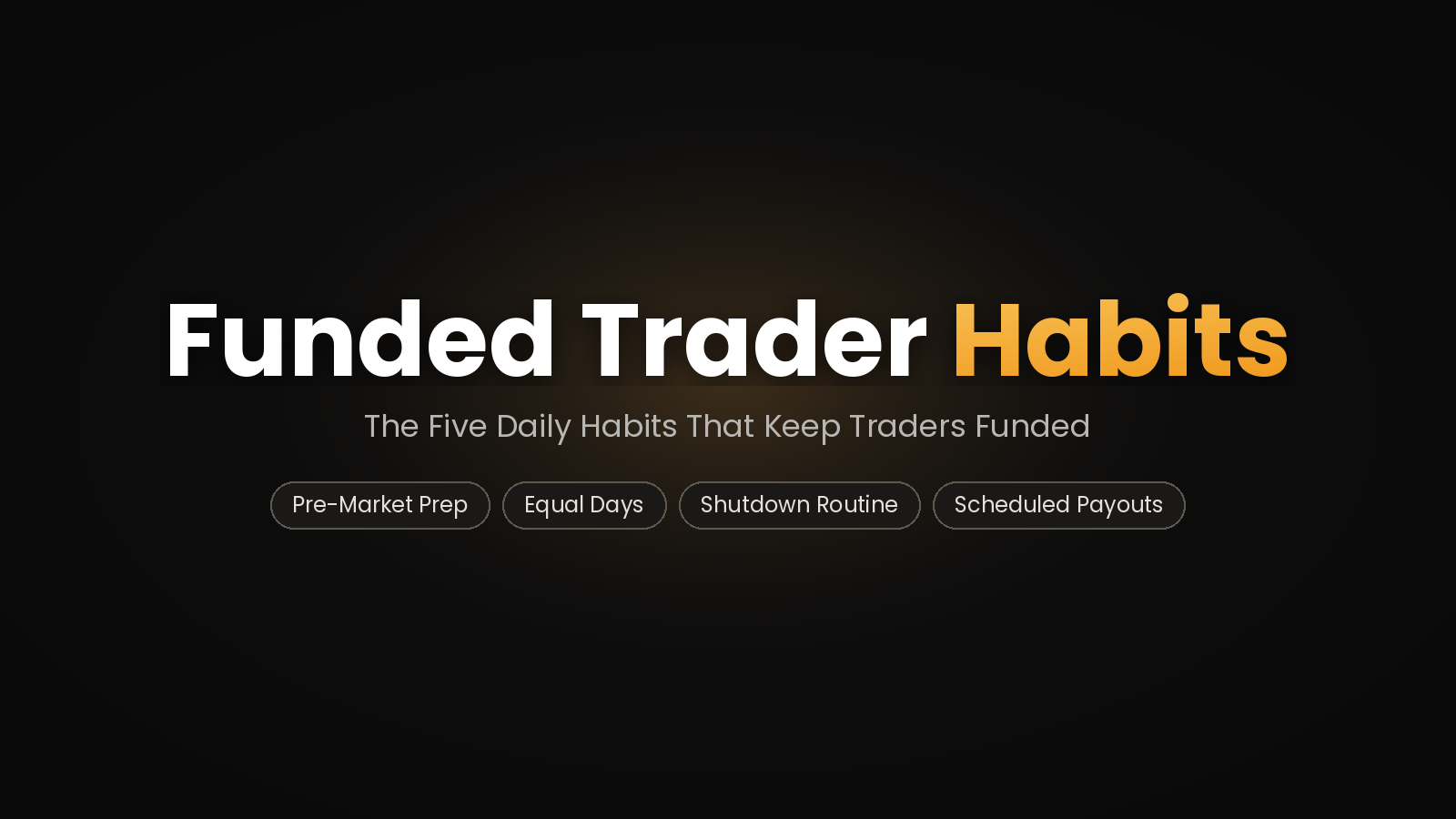
Getting funded is a milestone. Staying funded is a lifestyle, and it is built out of small, boring, repeated actions that nobody posts about.
Here is the pattern behind most funded account failures: the trader passed the evaluation on skill, then lost the account to inconsistency. Different sizes on different days, random trading hours, no preparation one morning and too much caffeine-fueled conviction the next. The skill did not disappear. The structure around it never existed.
At Chart Academy, we give traders free trading psychology courses and masterclasses led by professional traders. This guide covers the good trading habits for funded traders that turn one passed evaluation into a lasting funded career: what to do before, during, and after every session, and how to make it automatic.
What Makes a Habit Different From a Rule?
The two get mixed up, and the difference matters because they are built differently.
A rule is a limit you obey under pressure: your risk per trade, your daily loss limit, your stop staying where you put it. Rules are about resisting something. We covered the rule system in trading discipline.
A habit is something you do automatically, at the same time, in the same way, without spending willpower on it. Checking the economic calendar with your morning coffee. Logging the day before closing the platform. Habits are about never having to decide.
The connection: good habits make the rules easier to keep. A trader who prepared a plan at 9:00 has something to be disciplined about at 10:30. A trader who sat down cold has nothing but impulses. This article is about building that structure.
Habit 1: The Same Preparation Every Morning
Funded traders do not start their session by looking for trades. They start by filling in the same short checklist, every day, before the market can pull them anywhere.
The practical version takes about fifteen minutes. Check the economic calendar for the day's scheduled releases and mark the times you will not trade through. Mark the price levels that matter on your market today. Then write down, in one or two lines, what you are looking for: the setup, the direction that makes sense, and what would make you stand aside.
The output matters less than the repetition. A trader who has written "looking for longs above yesterday's high, nothing before the 8:30 release" has pre-made the morning's decisions. When the open gets loud, they are comparing the market to a plan instead of reacting to a screen.
Habit 2: One Market, One Setup, One Window
The funded traders who last are almost boringly narrow. They trade the same market, hunt the same setup, during the same hours, every single day.
This is a habit, not a limitation. Trading the same thing daily is what builds pattern recognition: after two hundred sessions on one market, you know what its normal looks like, so you spot the abnormal instantly. It also protects the account. Most blown funded accounts involve a trader wandering outside their lane, a new market they do not know, a session they never trade, a setup they saw on social media that morning.
Make the lane physical: one instrument on the screen, your trading window in your calendar like a work shift, and everything else treated as not your job. Deciding what to trade should have happened weeks ago, not at 9:31.
Habit 3: Equal Days
Prop firms do not just want profit. They want profit that arrives in steady, similar-sized pieces, and some firms formally require it by limiting how much of your total profit can come from a single day. Even where it is not required, it is what separates traders who get scaled up from traders who get watched nervously.
The habit that produces steady equity is simple: same risk per trade every day, a similar number of trades every day, and no "pressing" on good days. If your normal day is two to four trades risking the same fixed amount each, then a day with nine trades at double size is a red flag in your own data, whatever the profit says.
The test is your own equity curve. If someone could spot your emotional days just by looking at your account balance chart, the consistency habit is not built yet. When every day looks roughly like every other day, you have become what firms are actually paying for: a repeatable process.
Habit 4: The Shutdown Routine
How a session ends predicts how the next one starts. Funded traders end every day the same way, win or lose, in about ten minutes.
Log the day's trades with their numbers and a screenshot of each setup. Note anything unusual, a data release that moved the market, a technical issue, a level that mattered. Then close the platform completely. Not minimized, closed. The session is over at the time you decided it was over, and the market's remaining hours are someone else's problem.
The screenshots deserve a special mention. Numbers tell you what happened, but screenshots teach you to see. A weekly scroll through your own setup pictures trains pattern recognition faster than anything else you can do off-market. Keep this log operational, what happened and where. What you felt belongs in the feelings journal from our trading psychology guide, and which rules held belongs to your discipline review. Three records, three different jobs.
Habit 5: The Payout Routine
The strangest habit gap in funded trading: traders who fight for months to get funded, then never withdraw a dollar.
Make payouts a schedule, not a celebration. Every payout cycle, request the withdrawal, move it to your bank, and let some of it be spent on real life. This does three things. It converts trading from a screen number into actual income, which is the whole point. It takes profit off the table before a bad stretch can hand it back. And it lowers the daily pressure, because a trader who has already banked real money trades the next session calmer than one whose entire result is still at risk.
The anti-habit to avoid: endlessly "rolling" profits toward a bigger account on impulse. Scaling up is fine when it is planned at a monthly review. It is a leak when it is a feeling.
| Habit |
When |
What It Prevents |
| Fixed preparation |
15 minutes before the session |
Reacting to the screen with no plan |
| One market, one setup, one window |
Every session |
Wandering into markets and hours you do not know |
| Equal days |
Every session |
The one outlier day that ends funded accounts |
| Shutdown routine |
10 minutes after the session |
Unlogged days and after-hours impulse trades |
| Scheduled payouts |
Every payout cycle |
Giving profits back and trading under pressure |
How Do You Make These Habits Stick?
Habits form through attachment and repetition, not motivation.
Attach each one to a trigger that already exists: preparation happens with the morning coffee, the shutdown routine starts when your trading window ends, the payout request goes in the same day the cycle opens. Start smaller than feels serious, a five-minute prep beats a skipped thirty-minute one. Build one habit at a time for a few weeks before adding the next, and track the streak somewhere visible, because an unbroken streak becomes something you protect.
And expect the habits to feel pointless on quiet weeks. That is normal. Their value shows up on the bad day, when the preparation, the narrow lane, and the shutdown routine quietly stop a loss from becoming a spiral.
Build Funded Trader Habits Free on Chart Academy
Routines are where the mental game becomes practical, and it is worth learning them from people who trade for a living.
Chart Academy’s trading psychology courses are taught by professional traders and coaches, and they cover exactly this ground: the pre-trade warm-up and post-trade cooldown, the professional versions of the preparation and shutdown habits in this guide, plus how to keep your habits standing through losses, wins, and boom-bust cycles. Free, no subscriptions, no credit card.
Build the routine professionals trade by. The Mental Game of Trading with coach Jared Tendler, free on Chart Academy.
Start free
Join Chart Academy Free
Chart Academy provides educational content and does not provide financial, investment, or trading advice. Trading involves a substantial risk of loss and is not suitable for everyone. Past performance is not indicative of future results.
Good Trading Habits for Funded Traders FAQs
What are good trading habits for funded traders?
The five that matter most: a fixed pre-market preparation routine, trading one market and one setup inside a set window, keeping every day similar in risk and trade count, a shutdown routine that logs the session and closes the platform, and withdrawing profits on a schedule. Together they produce the steady equity curve firms reward.
What is the most important habit for staying funded?
Equal days. Same risk per trade, similar trade counts, no pressing after wins or losses. Most funded accounts die on one outlier day, and the equal-days habit is what prevents outlier days from existing.
How long does it take to build a trading routine?
A few weeks per habit if you attach it to an existing trigger and keep it small. Build one at a time: preparation first, since it makes everything else easier, then the shutdown routine, then the rest. Stacking all five at once usually means keeping none.
What is the difference between trading habits and trading discipline?
Discipline is obeying your limits under pressure, like taking a stop or ending the day at your loss limit. Habits are the automatic routines around the session, like preparing every morning and logging every evening. Habits reduce how much discipline you need, because fewer decisions get left for emotional moments.
Why do prop firms care about consistency?
Because a trader who produces steady, similar-sized days is a repeatable process the firm can scale, while a trader whose profit came from one big day is a coin flip. Some firms enforce this formally by capping how much of your profit can come from a single day.
Should funded traders withdraw profits?
Yes, on a schedule. Regular payouts turn the account into real income, protect profits from being given back, and lower the pressure on every session. Scaling up should be a planned decision at a review, not a reason to leave everything at risk.
Where can funded traders learn these routines?
Chart Academy’s free trading psychology courses are taught by professional traders and cover the pre-trade and post-trade routines in this guide, plus how to keep good trading habits standing through wins, losses, and drawdowns.