.svg)

Matteo Conti

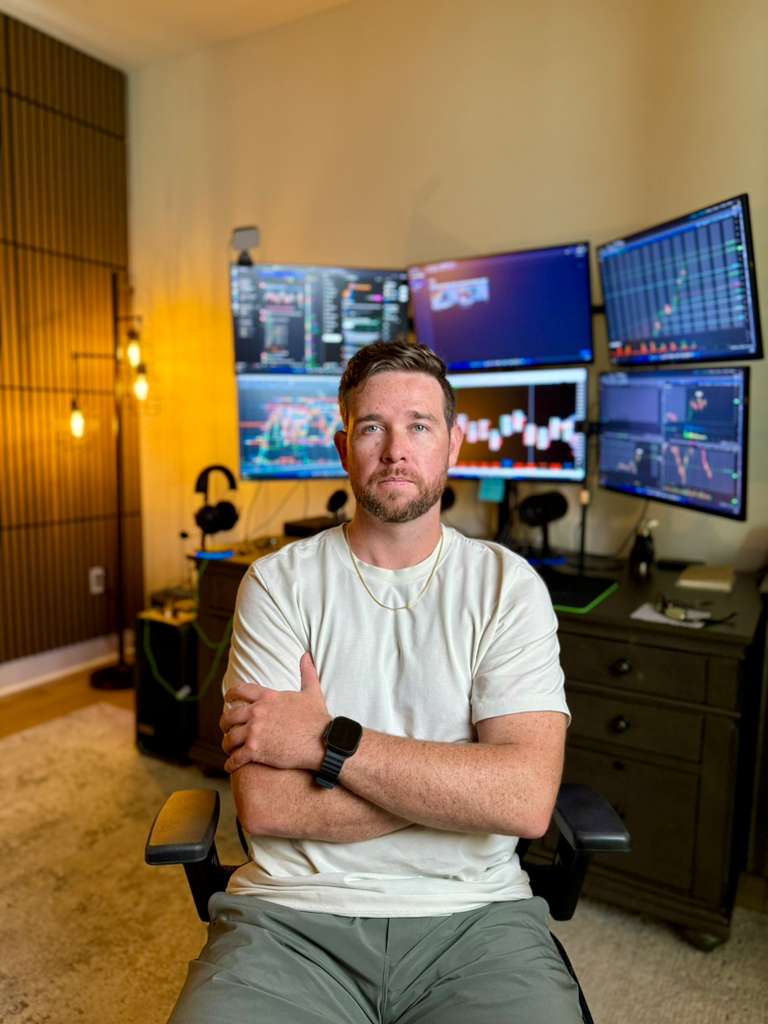
Matteo Conti is a hedge fund manager and former institutional market maker who spent 7 years at one of Europe's biggest banks, trading around 15 billion euros a year and generating 8-figure yearly P&L. He now teaches retail and prop firm traders how to research, test, and automate strategies the institutional way.


About Matteo Conti
Matteo Conti is a hedge fund manager and former institutional market maker who spent 7 years on the equity desk of one of Europe's biggest banks. There he traded around 15 billion euros a year, making markets in single stocks, funds, and futures for a client base of around 10 million people across the Nordics. Today he is building his own fund and teaching retail traders the process he followed on the desk.
His message to retail traders is simple: institutional traders don't make money because they have better infrastructure or more capital. They make money because they follow a process. They take an idea, turn it into rules, test it on years of data, validate the results, and only then trade it live. As Matteo puts it, every time you throw away a strategy without trading it because it doesn't work, that is money saved in the bank.
From University to the Trading Floor
Like most traders, Matteo started out seeing institutional traders as "gods on earth." He pictured them knowing everything, with secret indicators and secret strategies. Getting onto a trading floor meant studying 10 to 12 hours a day to earn the best grades possible. He describes the path in as applying for hundreds of jobs and taking part in hundreds of interviews, and he was lucky enough to land a seat in Copenhagen, Denmark.
When he arrived, he was almost disappointed. He had expected a lot of action and people screaming. Instead, he describes trading as a job of connecting dots on the back of research, using the tools on the desk. New traders were given six months to a year to build their first set of strategies before taking real risk.
The Scandinavian hierarchy is also unusually flat. In London, a graduate often spends three years as a desk analyst. Matteo worked as a desk analyst for about the first year before getting his own risk mandate as a market maker in 2019, with the same responsibilities as the senior traders.
COVID: The Moment That Flattened the Playing Field
Matteo's first eight months as a market maker were fairly quiet. Then COVID hit. Nobody on the trading floor, whether they were 21 or 60 years old, had ever seen anything like it, and in his words, the playing field flattened for everyone. He saw it as his opportunity. If he could survive that period and handle the risk properly, it would be his first real chance to show himself. As he put it, there are a few moments in a career when you have to show you're made of what you say you're made of.
Inside an Institutional Trading Desk
The real day-to-day of an institutional market maker looks very different from what retail traders imagine. Matteo would arrive at the office and make sure every algorithm was running correctly. From there, about 10 percent of his job was monitoring risk and performance, and the other 90 percent was research. That meant digging into data, developing new strategies, and replacing strategies that weren't performing as they should. No one starts with hundreds of algorithms. You build them up over the years, and many are similar strategies applied to different instruments.
He worked within strict rules. A risk mandate set which products he could trade, such as equities, FX, futures, or some options, and how much money he could put at risk on any given day. He couldn't wake up one morning and put on a massive Tesla options position. Every position also had to be justified by client activity. When a client wanted to buy, he sold to them, and when a client wanted to sell, he bought from them. Across 10 million clients and thousands of trades, that could build large positions, and his algorithms had to manage them. Around 2 percent of the work stayed manual, mainly making sure he stayed within his risk parameters. Sometimes that was frustrating. He might see activity in a stock he wanted access to but have no client flow to justify trading it.
He was also supported by teams of developers, quants, and risk managers. That is the support he believes retail traders can now partly replace at home with AI coding tools and good data providers.
The Truth About Institutional Trading
Matteo is direct when it comes to retail myths:
- Do banks hunt retail stop losses? No. On regulated markets like the CME, NASDAQ, and the New York Stock Exchange, institutional traders cannot simply track and hit orders whenever they want.
- Is the market really traded by algorithms? Yes. Around 98 percent of all trading is automated, especially in single stocks, futures, and FX.
- Do institutions always win? No. They have negative periods too. The difference is that 90 to 95 percent of their ideas are rejected during validation, and only 5 to 10 percent ever trade live. On top of that, they run a combination of uncorrelated strategies, which is what maximizes their chances of success month after month.
How Matteo Builds a Strategy
Every strategy has three elements: an entry, an exit, and a position sizing rule, all sitting on top of a reason why the strategy should make money. Matteo keeps strategies simple but not simplistic. A strategy with 3 rules has 3 breaking points. A strategy with 15 rules has 15.
His ideas often start in academic and industry research, but he never copies a paper directly. Once a paper is published, every university professor and hedge fund manager has access to it, and copying the exact same instrument and method means the strategy will be dead. Instead, he takes the reason behind the strategy and looks for where it still applies. That could be small and mid cap stocks instead of mega caps, or European markets instead of US markets. In his words, it is always a matter of adapting, never a matter of copying. Applying the same idea to less liquid instruments that fewer institutional players trade is where the gold is really hidden.
He tests and optimizes carefully to avoid overfitting. Rather than tweaking every parameter until the past 10 years look perfect, he splits the data and checks whether a change improves performance in both periods. For example, he might test a risk-to-reward of 1, 1.5, 2.5, and 3, rather than 1.1, 1.2, 1.3, and 1.4, and then just picking the best result for that period. When adding another parameter stops adding real value, he stops.
Monte Carlo: Knowing What Normal Looks Like
Matteo uses Monte Carlo simulations to set a yardstick for live trading. The simulations might show that after 10 trades the strategy should make around $2,000, and that it should not lose more than $7,000 over those 10 trades. If the strategy is down $5,000, he knows it is within the expected parameters. If it is down $8,000, it is outside them, and he stops trading it.
He also separates a broken strategy from an underperforming one. If a strategy that is not supposed to lose more than $10,000 reaches $11,000 or $12,000 in live trading, it goes in the bin, because it has stopped working. If its average trade is simply much lower than in testing, he may pause it and keep monitoring to see whether it moves back toward what the backtest and simulations showed.
That is what he means when he says testing gives you awareness. If you know what you're doing, you're not afraid of the outcome unfolding in front of your eyes.
Why Matteo Automates
For Matteo, automation does three things. First, it frees your time. If it is 2026 and you are still spending six hours in front of a monitor waiting for your entry conditions, a machine can do that for you. Second, it removes emotions, because the exact rules you tested over 10 years of data are the rules that get executed. Third, it lets you run several strategies at once, such as a trend-following strategy alongside a mean reversion strategy, so they compensate for each other as market conditions change. He says you cannot do that systematically by trading manually in front of your screens.
Once a strategy is live, he doesn't interfere with it. Skipping a trade, increasing the size, or closing a position early means you are trading a strategy you haven't tested, and you throw away all the work you did before.
Closing the Gap With AI
Matteo believes the gap between retail and institutional trading is shrinking at a pace that is unprecedented. The biggest barrier to entry was always knowing how to code, and since ChatGPT went mainstream in 2023, that barrier has disappeared. As he puts it, you now have a developer on your laptop for $20 a month.
He treats AI like a real developer. Rather than asking for a finished, bug-free strategy all at once, he builds it step by step. First the entry, checked and validated. Then the exit conditions, the stop loss, and the take profit, checking the execution every time until the code is fully working and can be trusted. It might take a week longer, but you are giving that code access to your own money. And he reminds traders that today we are using the worst version of these AI models we will ever use.
For backtesting and automation, his absolute favorite platform is MultiCharts, because it is built for realistic, reliable backtesting and automated execution. He says you can do something similar with TradingView or NinjaTrader, or build your own setup in Python if you know what you're doing. If you have limited coding knowledge, he recommends a purpose-built platform, because if you make a mistake building your own backtesting setup, you cannot rely on the results.
Retail traders also have a speed advantage. Inside a bank, AI adoption is slow because of security concerns. Matteo's bank had around 30,000 people and no control over who was feeding what data into these tools. And very few institutional traders are automating strategies in crypto or prediction markets yet. A retail trader who knows how to test, validate, and automate a strategy can be a first mover when opportunities like these appear.
The Prop Firm Angle
Matteo's process applies directly to prop firm traders. Prop firms have very strict rules, and in his view the easier way to pass a challenge is to go rule by rule. If you can develop a strategy that respects those rules and statistically passes a challenge more often than not, it is one plus one equals two. Once you pass, you follow exactly the same steps again, this time building a strategy that maximizes your probability of a payout.
Leaving the Bank to Build His Own
Matteo spent 7 years at the bank building something that he says turned out to be truly exceptional. But he realized it would never be his. When you build something under a bank's umbrella, it always belongs to the bank. He started asking himself: what if he spent the next 10 years building something he could call his own? He felt it was the right moment, while he had the know-how and before it was too late to take the leap.
He also remembered that at 16 he would have paid so much to access this kind of knowledge, and that it would have saved him a lot of money. No one was teaching the actual process of developing and testing a strategy. So he began sharing the information he wishes he had had access to at 17.
He has since grown an Instagram audience of more than 55,000 followers. He also built a community where retail traders share their experience, share strategies, request feedback, and help each other with code. He says this was missing in the retail trading space, and he has seen people pick up the process at a much quicker pace since.
His bigger goal is his fund, which he calls his 10-year project. That means raising capital, building partnerships, translating his market-making logic, and building the infrastructure. He points out that a new fund needs at least two years of capital to cover its operating expenses, and he does a lot of risk management on the business side as well. His dream is to have his own company with a physical office and trading floor, filled with people trained in his investment and trading philosophy. He knows it will take years, and he focuses on improving 1 percent every single day.
Matteo's Advice to Traders
Matteo is honest that this way of trading is a lot of work. There is no free money in the market. The money is the result of the work you put in. You trade the adrenaline and the gambling factor of waiting for a pattern for hours spent developing strategies. Some traders find it painful to work on a strategy for days only to throw it in the bin. You can call it more boring, he says, but it is the way you actually come out successful. And the work compounds. Once your strategies are built, you don't necessarily need to spend the same hours in front of your computer.
You also don't need to adopt everything at once. He says that realistically, the full process takes a couple of months to learn. But you can start backtesting your strategies properly or running simple Monte Carlo analysis right away, and become a more aware trader immediately. And when something new comes to the market, he pays attention and studies it before trading it. You don't trade something just because it's new.
His final advice is to slow down. You have time. Don't think that today is the last day you can make $1 million. You are at the beginning of your journey, the technology is going to keep getting better, and inefficiencies are still going to be there in 10 years. Right now is the building phase.
Learn From Matteo Conti on Chart Academy
Matteo recorded a free 15-lesson masterclass on Chart Academy called Automate Your Prop Firm Trading. In it, he takes the institutional approach he used at the bank and applies it to one problem: how to maximize your probability of passing a prop firm challenge. Most traders see a challenge as one attempt that they either pass or fail. Matteo shows how to approach it as a business instead.

He starts with the gap between retail and institutional traders and the pipeline institutions follow every day: idea, rules, code, backtest, validate, size, deploy. Then he covers the three tools every retail trader needs: a backtesting platform, market data, and an AI coder like ChatGPT or Claude. From there, he treats the prop firm challenge as a statistical problem. He maps every account rule into code, chooses the right account size, runs Monte Carlo simulations to find the optimal contract size, and shows how running multiple uncorrelated strategies improves your odds. The masterclass closes with the funded phase, where the goal shifts from passing to preserving capital and maximizing payouts.
Frequently Asked Questions
Who is Matteo Conti?
Matteo Conti is a hedge fund manager and former institutional market maker. He spent 7 years on the equity desk of one of Europe's biggest banks, trading around 15 billion euros a year for a client base of around 10 million people across the Nordics. He now teaches retail and prop firm traders how to build, test, and automate strategies the institutional way.
What markets does Matteo Conti trade?
As a market maker, Matteo traded single stocks, funds, and futures. His systematic process can be applied to stocks, futures such as the NASDAQ 100, and newer markets like crypto and prediction markets.
What is Matteo Conti's trading strategy?
Matteo trades systematically. Every strategy has an entry, an exit, and a position sizing rule, built on a clear reason why it should make money. He tests each strategy on historical data, validates it on unseen data and with Monte Carlo simulations, automates it, and runs several uncorrelated strategies together.
Do banks hunt retail stop losses?
According to Matteo, no. On regulated markets such as the CME, NASDAQ, and the New York Stock Exchange, institutional traders cannot simply track and hit orders whenever they want.
What is the biggest mistake retail traders make?
Matteo says the biggest mistake is believing you have to trade an idea live to find out whether it works. Instead, you can get historical data, have an AI model code a simplified version of your strategy, and test it before risking money with your own capital or a prop firm.
Can retail traders trade like institutions?
Matteo believes they can. The main difference will always be access to capital and infrastructure, but that is not why institutions make money. They make money because they follow a specific process. With AI coding tools, quality data, and good backtesting software, retail traders can now follow the same process from home.
How long does it take to start trading systematically?
Matteo says the full process realistically takes around a couple of months to learn. But you can adopt parts of it immediately, such as backtesting your strategies properly or running a simple Monte Carlo analysis.
What can I learn from Matteo Conti on Chart Academy?
On Chart Academy, Matteo teaches Automate Your Prop Firm Trading, a free 15-lesson masterclass. It covers the institutional trading pipeline, using ChatGPT or Claude to code your rules, mapping prop firm rules and drawdown types, choosing the right account size, running Monte Carlo simulations to find the optimal contract size, running multiple uncorrelated strategies, and managing a funded account to maximize payouts.
What is Chart Academy?
Chart Academy is a free, all-in-one trading education platform designed to help traders learn real, practical skills from world-class traders. It offers in-depth masterclasses taught by real traders across stocks, options, futures, forex, crypto, and trading psychology. In addition to educational content, Chart Academy includes personalized learning paths, downloadable resources, and access to exclusive tools and rewards, all in one place. There are no subscriptions, no paywalls, and no credit card required. The goal is to make high-quality trading education accessible, practical, and easy to follow for traders of all levels.
Ready to learn Trading for Free?
Chart Academy is the world's first free, all-in-one trading education platform. Get Trading Masterclass taught by world-class traders, plus guides on every market. No subscriptions, no credit card.

.svg)

More Instructors