.svg)

Navroop Sandhu

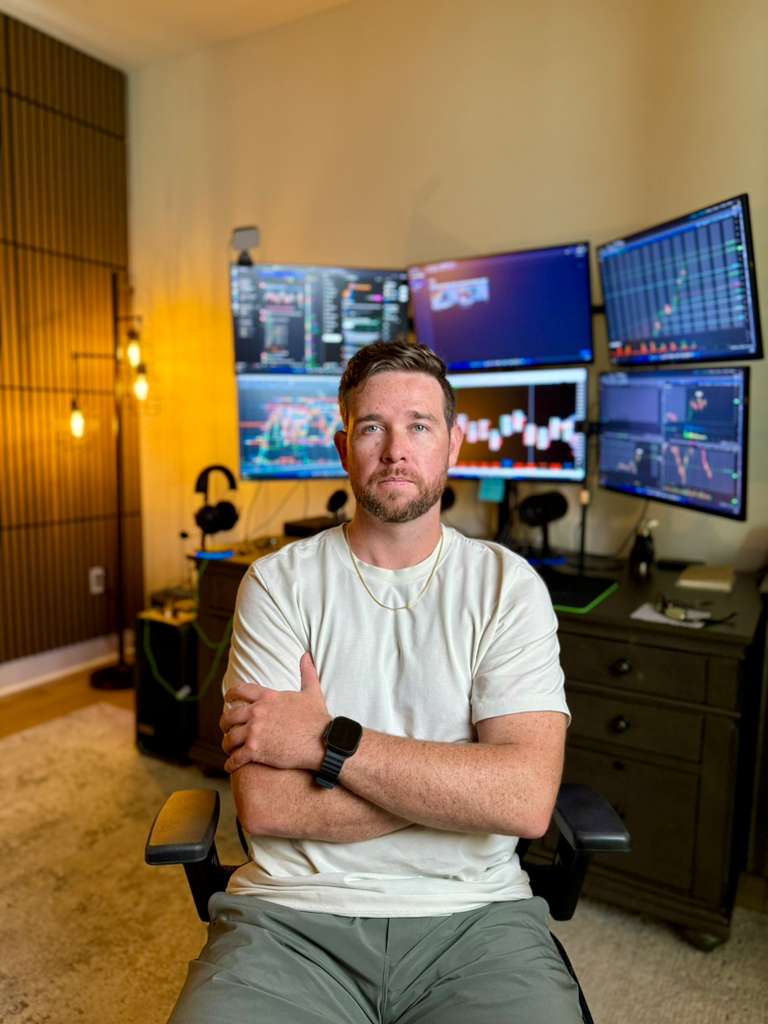
Navroop Sandhu is a trader and trading psychology coach who helps traders close the gap between knowing what to do and actually doing it. She believes trading is 10 to 20 percent strategy and 80 to 90 percent psychology, and she works with traders on the beliefs, habits, and identity that drive their results.


About Navroop Sandhu
Navroop Sandhu is a trader and trading psychology coach. Her work starts where most traders get stuck: "I know what to do. I just can't seem to do it."
Most traders think they are one strategy tweak away from becoming profitable. Navroop calls that one of the biggest lies traders tell themselves. In her experience, trading is 10 to 20 percent strategy and 80 to 90 percent psychology. Two people can trade the exact same strategy, and one is profitable while the other isn't. The difference is the person.
She is open that she isn't a licensed psychologist. As she puts it, she is a trader who figured it out. She doesn't claim to know everything, but she knows what traders need.
The Problem Isn't Your Trading
When traders struggle, they usually point to revenge trading, overtrading, or overleveraging. Navroop sees those as symptoms, not the real problem. The underlying problem is a gap between the trader someone is trying to become and who they are right now.
So she doesn't try to fix a trader's trading. She works on aligning their identity with the identity of a consistently profitable trader. When that happens, she says, better results come as a byproduct.
Much of that gap comes from beliefs people grow up with. From a young age, many people learn that money matters and that not having enough of it means missing out. Over time, they wire in the belief that money equals freedom. Navroop believes the opposite: freedom is a state you can feel now. Money doesn't create it.
Your Relationship With Money
Navroop asks traders to see money as a partner. Imagine a partner who shows up for you every day, while you keep treating them as if they're about to leave. Eventually, that partner walks away. She believes traders do the same thing with money when they oversize, or treat their account as something they're willing to lose.
Respecting money looks different. Instead of being willing to lose $500 or blow an evaluation, you decide you're only willing to lose $200 on a position. Then you take that risk from a place of trust that the money will come back to you. When traders stop acting from scarcity, she says, they stop pushing money away.
Why Your Brain Keeps Repeating Bad Habits
Navroop explains that around 95 percent of what drives us comes from the subconscious, and only around 5 percent from conscious thought. Knowing where your entry is sits in that 5 percent. By the time you think about it, your brain has often already decided.
Your brain's main job isn't making money. It's keeping you alive. If you repeat a habit, like revenge trading, your brain remembers that you survived it, so it takes that familiar route again. When a candle moves against you, your brain can treat it as a threat. In that survival state, she explains, the part of the brain responsible for logical decisions goes offline, and the part responsible for threat detection takes over.
Her first tool is simple. It's a neuroscience technique called decoupling, which means labeling the thought. Instead of "I keep losing," you say "I'm feeling fear." That small step separates the thought from your identity and gives you a better chance of making a logical decision, like getting up from your desk.
Meditation and Negative Visualization
Navroop used to think meditation was made up. Today it's a core part of her work. She explains that meditation isn't the art of stopping your thoughts, it's the art of observing them. Meditation can put the brain into a theta state, which she says is where you can rewire the subconscious.
The meditations she uses with traders are built for trading. She walks traders through their trading day, including the hard parts. She uses negative visualization, having traders sit with a losing trade in their mind. Because the brain doesn't fully separate what is imagined from what is real, she explains, traders who have rehearsed a loss aren't facing it for the first time when it happens on the chart. She compares it to how air force pilots and athletes train. Trading, she says, is a mental performance sport.
The goal isn't to sit in the bad feeling. It's to feel it now, then practice shifting it. If a loss feels so bad that you can't see it as part of the game, that's a sign your size is too big. Size down until you're comfortable. She recommends visualizing just after waking up and just before bed, but says you can use it whenever your state shifts during the day.
Losses, Wins, and Self-Sabotage
Navroop believes many traders carry a childhood relationship with losing, from losing a race at sports day to failing a test. In the market, a loss doesn't mean what it means in everyday life. It's neutral. It's just part of the game.
Winning can be just as hard. Many traders subconsciously link more money with more responsibility, so they sabotage themselves when they start doing well. If you feel resistance when you're winning, she says that's a good thing. It shows you where your current limit is. You aren't yet the person who can hold that amount of money, but you can become them.
One of her suggestions surprises people: learn to spend money. Not into your overdraft, but on things that build you, like your skills and your health. Navroop says holding on to money too tightly kept her stuck at the same level, and she started growing her wealth when she let go of that grip.
Navroop's Trading Journey
Navroop was profitable as soon as she started. She treated trading like a serious job. She watched the NASDAQ on a one-minute chart for up to 21 hours a day, woke up at 1:30 a.m. to watch the Asian session, kept the news feed running constantly, and studied tick data. She also traded the German DAX, which she still likes for her personal portfolio. The first time she called herself a trader, she says, no job had ever felt so right.
About a year and a half in, she had grown her portfolio to around $80,000 to $100,000. Then she gave most of it away to help a friend in need. Going from that level back down to around $5,000 changed everything. No win felt satisfying anymore. She started revenge trading and overleveraging, trying to get back to her old number. She watched trades go from up $20,000 to down $15,000. Nothing about her strategy had changed. Only her mindset had.
That was when she sat down with herself and started doing the deep work. She asked what she had believed before and what she was believing now. She didn't turn to the usual trading books. Instead she read books like Behave, about the biology of human behavior, and built her own understanding of how the mind works.
Introspection has always been part of who she is. She studied psychology in college, and she remembers a turning point at school. After getting an E on an assignment, she realized, "No one's coming to save me." Her grades went from E to straight A's, and that work ethic has stayed with her.
How Navroop Coaches Traders
Navroop doesn't just look at what a trader wants. She looks at what their higher self is trying to show them. That's why she might give two traders completely different advice. For her, information only matters if you know how to apply it.
She also believes even great traders need a coach. A boxer knows how to throw a punch, she points out, but still has a coach in their corner. Through her Market Mindset coaching, she helped one trader break through a $300,000 ceiling to $1.4 million in four sessions. She has also worked with traders who spent five years unprofitable, including some who had been in therapy, and helped them reach five-figure payouts. In her words, nothing about their strategy changed. Their psychology did.
Navroop's Advice to Traders
- Learn one proven strategy first. If you don't know where to enter a trade, you'll blame your mindset. Find one proven strategy that fits your personality, and don't mix and match. Once you have that, if you're still messing up, you know the issue is psychology.
- Stop waiting five years for it to click. Many traders believe profitability takes five years, but often the only thing that changes in those years is their mindset. Why not work on it now?
- Discipline isn't the answer. Navroop believes the biggest myth in trading psychology is that you just need to be more disciplined. Self-awareness matters more.
- Fix your relationship with losses. If you feel the urge to trade again right after a loss, it's likely because revenge trading worked for you before. Accept the loss, walk away, and let probabilities play out in your favor.
- Pick your hard. Everyone faces fear and challenges. Choose the hard that comes with growth. Every time you overcome it, you level up.
Learn From Navroop Sandhu on Chart Academy
Navroop's free masterclass, The Profitable Trader Identity, is coming soon on Chart Academy.

Frequently Asked Questions
Who is Navroop Sandhu?
Navroop Sandhu is a trader and trading psychology coach. She helps traders close the gap between knowing what to do and actually doing it, by working on the beliefs, habits, and identity behind their trading results.
Is trading more about strategy or psychology?
Navroop believes trading is 10 to 20 percent strategy and 80 to 90 percent psychology. Two traders can use the same strategy and get completely different results, because of the person trading it.
Why do traders keep revenge trading?
According to Navroop, revenge trading and overtrading are symptoms, not the real problem. If revenge trading has worked for you in the past, your brain learns that losses are something to fix. She recommends fixing your relationship with losses, accepting them as part of the game, and walking away.
What is decoupling in trading?
Decoupling is labeling a thought to separate it from your identity. Instead of thinking "I keep losing," you say "I'm feeling fear." Navroop says this simple step helps keep the logical part of your brain online, so you have a better chance of making a good decision.
Does meditation help with trading?
Navroop believes it does. She explains that meditation isn't about stopping your thoughts, but observing them. She uses trading-specific meditations and negative visualization so traders can rehearse difficult moments, like a losing trade, before they happen.
Do you need a strategy before working on trading psychology?
Yes. Navroop says traders should first learn one proven strategy that fits their personality, without mixing and matching. Once they have that, if they keep making mistakes, they know the issue is psychology, not strategy.
What can I learn from Navroop Sandhu on Chart Academy?
Navroop's free masterclass, The Profitable Trader Identity, is coming soon on Chart Academy.
What is Chart Academy?
Chart Academy is a free, all-in-one trading education platform designed to help traders learn real, practical skills from world-class traders. It offers in-depth masterclasses taught by real traders across stocks, options, futures, forex, crypto, and trading psychology. In addition to educational content, Chart Academy includes personalized learning paths, downloadable resources, and access to exclusive tools and rewards, all in one place. There are no subscriptions, no paywalls, and no credit card required. The goal is to make high-quality trading education accessible, practical, and easy to follow for traders of all levels.
Ready to learn Trading for Free?
Chart Academy is the world's first free, all-in-one trading education platform. Get Trading Masterclass taught by world-class traders, plus guides on every market. No subscriptions, no credit card.

.svg)

More Instructors