Trading Foundation
Options Trading Basics: Terminology Every Beginner Must Master
Every options term explained simply: premiums, strikes, in and out of the money, open interest, spreads, and the order terms your broker uses.
Read more →


Futures trade 23 hours a day, but a few hours do most of the moving. See when futures open and close, the busiest windows, and where beginners should start.

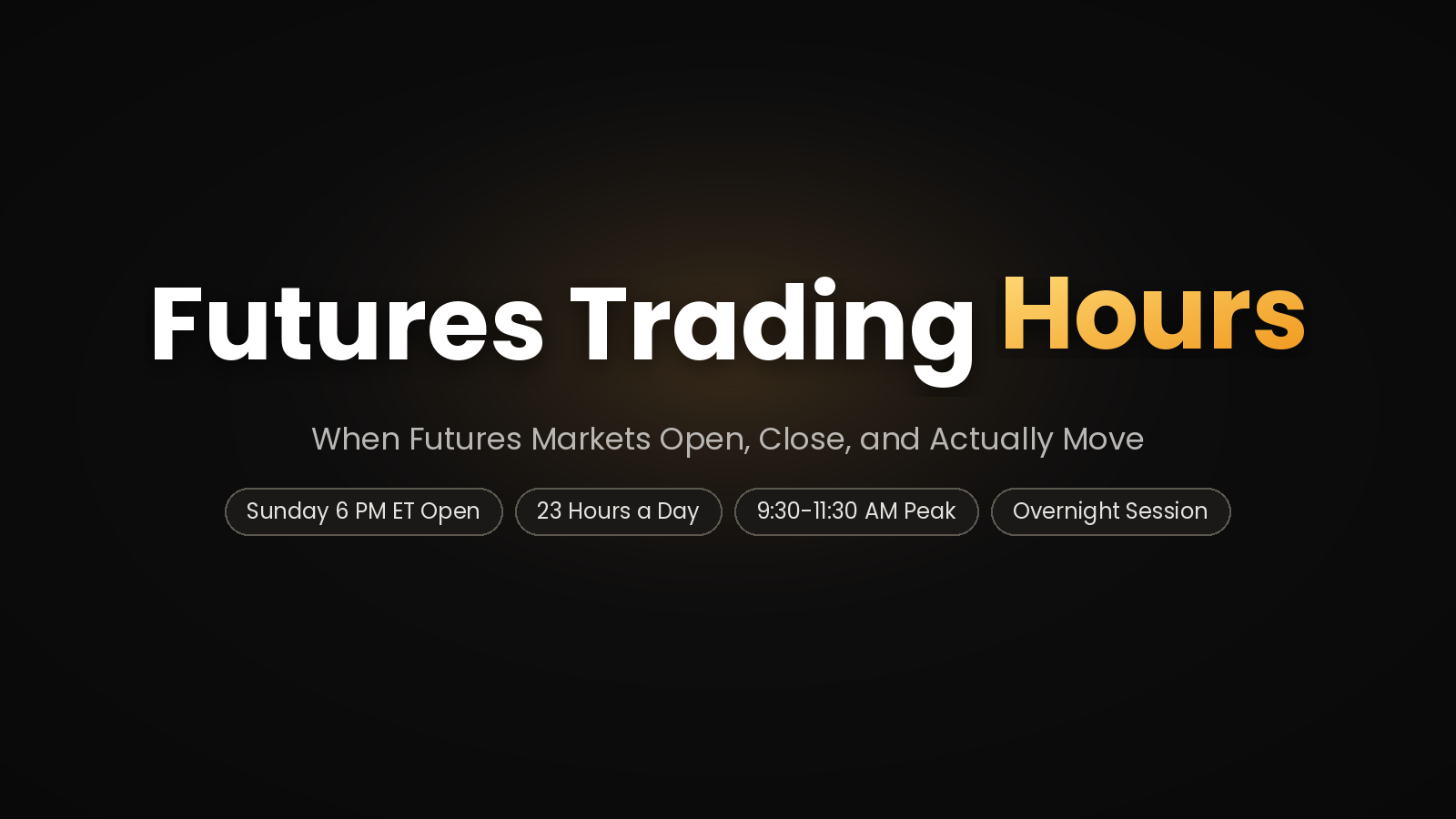
Futures trade almost around the clock. The market opens Sunday at 6 p.m. Eastern Time, runs until Friday at 5 p.m. ET, and pauses for one hour each day from 5 p.m. to 6 p.m. ET. That is the quick answer.
The useful answer is that these hours are not all the same. The futures day has a violent open, a productive morning, a dead midday, a busy last hour, and a long overnight stretch that behaves like a different market. Knowing which hours are which is one of the simplest edges a beginner can build.
At Chart Academy, we give traders free access to education led by professional traders. This blog covers futures trading hours in plain language: when the market opens and closes, when it is most active, what happens overnight and at the Sunday open, and which hours make sense while you are still learning.
Most major futures contracts, including stock index futures, trade from Sunday 6 p.m. ET to Friday 5 p.m. ET. Each weekday, trading stops at 5 p.m. ET and reopens at 6 p.m. ET. That one-hour pause is the market's daily reset: accounts are settled, and the new trading day officially begins at the 6 p.m. reopen.
This is where the phrase "futures trade 23 hours a day" comes from. Five days a week, one hour off per day.
Not every product follows the same clock. Stock index, energy, metal, and currency futures each keep schedules set by their exchange, and some agricultural contracts trade much shorter days. Before trading any contract, check its specific hours on your platform. If contracts, ticks, and margin are still new to you, start with our futures trading for beginners guide.
The busiest stretch of the futures day lines up with the US stock market. For stock index futures, this window runs roughly 9:30 a.m. to 4:15 p.m. ET and is often called the regular session or day session. Inside it, a few windows matter more than the rest.
The first two hours, 9:30 to 11:30 a.m. ET. Volume and movement are at their highest, institutions are most active, and price behavior tends to be at its most repeatable. Many professional futures traders do most or all of their trading in this window and are finished before lunch.
8:30 a.m. ET. Major US economic reports, like inflation and jobs data, are often released at this time. Futures can move sharply within seconds of a release, in either direction. Beginners are usually better off watching these moments than trading them.
2 p.m. ET on Federal Reserve days. Interest rate announcements land here roughly eight times a year, and the first reaction often whips both directions before the market picks one.
The last hour, roughly 3 to 4 p.m. ET. Volume returns as the stock market heads into its close and larger players adjust positions. There is movement here, but it can be choppier than the morning.
Midday, roughly 11:30 a.m. to 2 p.m. ET, is the quiet zone. Volume thins, moves stall and reverse, and many experienced traders simply step away. More losing beginner trades come from boredom in this window than most people expect.
Yes, and this is one of the biggest differences between futures and stocks. Outside the day session, futures keep trading through the evening and overnight in what is called the overnight or extended session.
Overnight activity follows the rest of the world. Asian markets are active during the US evening, European markets take over in the early US morning, and stock index futures react to global news the whole way through. That is why futures prices at breakfast already reflect everything that happened while you slept.
The trade-off is thinner participation. The overnight session generally has lower volume than the day session, which means fewer contracts changing hands, sometimes wider spreads between buyers and sellers, and slower, drift-like movement. That does not make it useless. Traders with day jobs, and traders who hold positions for days rather than minutes, often use the overnight hours to plan and manage positions calmly. It is simply a different market: quieter, thinner, and more sensitive to overseas headlines.
Sunday at 6 p.m. ET is the only true weekend gap in futures. Everything that happened on Saturday and Sunday gets priced in at once when trading resumes, so futures can open noticeably higher or lower than Friday's close.
Two cautions for beginners. First, volume in the opening Sunday hours is thin, so prices can swing on very little activity. Second, if you held a position over the weekend, a gap can jump straight past your stop order. A stop is not a guarantee: in a fast or gapping market it may fill at a worse price than you set, or in rare cases not at all. Many beginners avoid holding futures positions over the weekend for exactly this reason.
Pick one window and learn it well. For most beginners, the strongest case is the morning session, especially the first two hours after the 9:30 a.m. ET stock market open. That is when the market is most liquid, its behavior is most consistent, and most professional education applies, because that is when professionals actually trade.
If your schedule rules out mornings, the overnight session can work, with adjusted expectations: fewer clean moves, thinner volume, and slower decisions. Whichever window you choose, avoid the minutes around major data releases at first, and be careful in the midday lull, where boredom produces more trades than opportunity does.
And before trading any window with real money, spend time just watching it. Every part of the futures day has a personality, and the cheapest way to learn it is on a simulator, screen time first, money later. Our guide on how to trade futures covers the order types and risk basics you will need once you get there.
Knowing the clock is step one. Reading what the market does inside those hours is the real skill, and it is easier to learn from someone who trades them every day.
On Chart Academy you can learn futures trading free with Carmine Rosato's Futures Masterclass. He trades the first two hours of the morning session and walks through exactly how he approaches the open, step by step, on real charts. No subscriptions, no credit card.
Chart Academy provides educational content and does not provide financial, investment, or trading advice. Trading involves a substantial risk of loss and is not suitable for everyone. Past performance is not indicative of future results.
Most major futures contracts open Sunday at 6 p.m. ET and close Friday at 5 p.m. ET, with a one-hour pause every day from 5 p.m. to 6 p.m. ET. The new trading day begins at the 6 p.m. reopen.
Almost. Major contracts trade about 23 hours a day on weekdays, with a one-hour daily pause. The market is fully closed from Friday 5 p.m. ET to Sunday 6 p.m. ET.
The most active window for stock index futures is the morning of the US stock session, especially 9:30 to 11:30 a.m. ET, when volume is highest and moves tend to follow through best. Quieter windows suit traders who hold positions longer.
No. Trading stops Friday at 5 p.m. ET and resumes Sunday at 6 p.m. ET. Weekend news gets priced in all at once at the Sunday open, which is why prices can gap from Friday's close.
The daily pause from 5 p.m. to 6 p.m. ET is the settlement break. Accounts are settled at the day's closing prices, and the next trading day officially begins when the market reopens at 6 p.m. ET.
No. Futures trading hours vary by product. Stock index futures trade nearly 23 hours a day, while some agricultural and other contracts keep shorter schedules set by their exchange. Always check the hours for your specific contract before trading it.
Chart Academy is the world's first free, all-in-one trading education platform. Get Trading Masterclass taught by world-class traders, plus guides on every market. No subscriptions, no credit card.

.svg)


Futures come down to three ideas: contracts that expire, margin that works as a deposit, and leverage that comes built in. This guide explains each one in plain English, walks through a simple example trade, and lays out the steps to start without risking real money on day one.