Figuring out how to trade futures can feel confusing before you have even placed an order. You may hear about contracts, margin requirements, tick values, and leverage, without anyone explaining what a futures contract actually is or how much money trading one really takes.
The mechanics are learnable, and in some ways simpler than stocks. There are a handful of major contracts instead of thousands of tickers, and the markets run nearly around the clock. The one thing futures demand in return is respect for leverage, because it's built into every contract.
At Chart Academy, we give traders free access to education led by professional traders. This blog explains how futures trading works, what margin actually is, and how beginners realistically start.
What Are Futures?
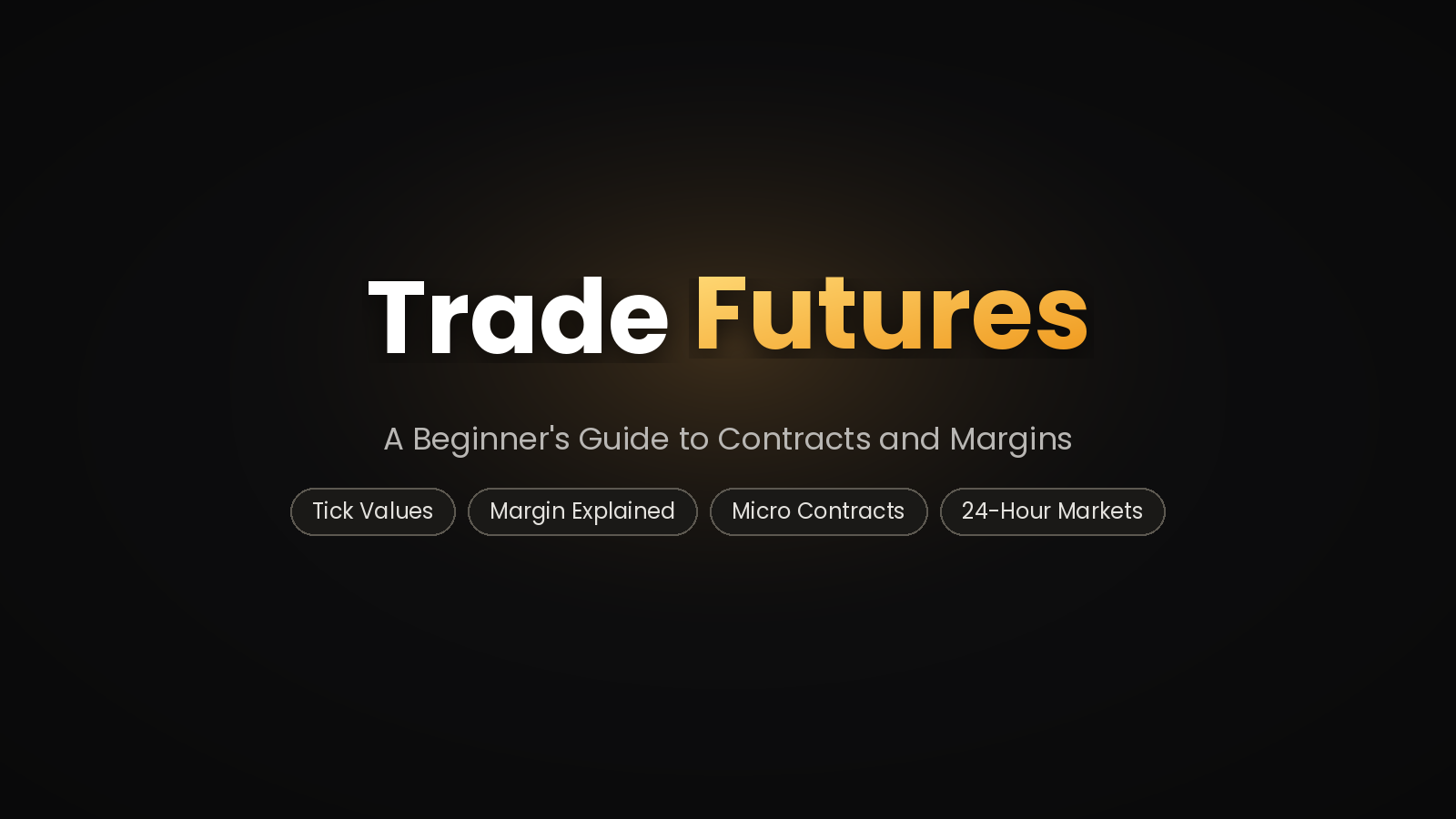
A futures contract is an agreement to buy or sell something at a set price on a set future date. The "something" can be a stock index, crude oil, gold, currencies, or interest rates, and the contracts trade on regulated exchanges, the largest being CME Group.
Two facts remove most of the mystery. First, almost no one takes delivery of anything. Traders close their positions before expiration, and the most popular contracts for individuals, the stock index futures, settle in cash anyway. You're trading the price of the agreement, not barrels of oil. Second, every contract is standardized: its size, its minimum price movement, and its expiration are fixed by the exchange, so every trader is trading exactly the same thing.
Like forex, futures let you profit from falling prices as easily as rising ones. Selling first and buying back later is a normal trade, not a special technique.
How a Futures Contract Works: Ticks and Tick Values
Every futures contract moves in fixed steps called ticks, and each tick is worth a fixed dollar amount. This is the arithmetic that makes futures risk knowable in advance.
Take the E-mini S&P 500, symbol ES, the most traded stock index future. It moves in ticks of 0.25 index points, and each tick is worth $12.50. If you buy one ES contract and the index rises 10 points, that's 40 ticks, or $500. If it falls 10 points, you've lost $500. The math never changes, which means before any trade you can calculate exactly what a move of any size will do to your account.
Every contract has its own tick value, which is why the first homework in futures is learning the specification of the one contract you plan to trade.
| Contract |
Symbol |
Tick Size |
Value Per Tick |
| E-mini S&P 500 |
ES |
0.25 points |
$12.50 |
| Micro E-mini S&P 500 |
MES |
0.25 points |
$1.25 |
| E-mini Nasdaq-100 |
NQ |
0.25 points |
$5.00 |
| Micro E-mini Nasdaq-100 |
MNQ |
0.25 points |
$0.50 |
What Is Margin in Futures Trading?
Margin means something different in futures than in stocks, and the difference matters.
In stocks, margin is borrowed money. In futures, margin is a deposit, called a performance bond, that you post to hold a position. You're not borrowing anything and paying no interest. The exchange sets minimum margins for holding positions overnight, and brokers often set lower requirements for positions opened and closed within the day. These numbers vary by broker and change with market volatility, so always check your broker's current requirements rather than relying on any article's figures.
Here's the part that deserves the most respect: margin is a deposit, not a maximum loss. If a position moves against you beyond what your account can support, your broker can close it and you owe the losses, which can exceed your original deposit. This is different from buying an option, where the premium is the most you can lose. Futures losses are open-ended until you close the position or your stop order does.
Micro Contracts: How Beginners Actually Start
For years the honest advice about futures was to wait until you had a large account. Micro contracts changed that.
Micros are one-tenth the size of the standard e-mini contracts. The Micro E-mini S&P 500, symbol MES, moves in the same 0.25-point ticks, but each tick is worth $1.25 instead of $12.50. The same 10-point move that means $500 on ES means $50 on MES. Same market, same chart, same skills, one-tenth of the consequence.
This is what makes futures learnable with a modest account: you can trade the real market, with real money and real emotions, while keeping each mistake small. Most beginners should plan to trade one micro contract at a time for months, not weeks, before even considering size.
When Do Futures Markets Trade?
The major futures markets trade nearly 24 hours a day, from Sunday evening to Friday afternoon US time, with a short daily pause. This solves a genuine problem for people learning around a job: the market is open in the evening.
Open doesn't mean equally liquid. For US index futures, the deepest and cleanest trading happens during US stock market hours, while overnight sessions are thinner, with wider spreads and different behavior. Beginners should also know that positions held overnight require higher margin and are exposed to gaps when major news breaks while liquidity is thin.
Expiration and Rollover
Futures contracts expire. Stock index futures expire quarterly, in March, June, September, and December, and active traders simply move to the next contract before expiration, which is called rolling. Your platform will show which contract month is currently the most traded; that's the one to trade. For cash-settled contracts like the index futures, expiration means positions settle to cash rather than anyone delivering anything.
For a beginner closing every position within days, expiration is mostly an administrative detail, but it's one to know before it surprises you.
How to Start Trading Futures Step by Step
The sensible sequence looks like this.
Open an account with a registered futures broker. Futures are regulated by the CFTC, and you can verify any US futures broker's registration through the NFA. Learn the full specification of one contract, ideally a micro index future. Practice on a simulator next: most futures platforms include a paper trading mode with live prices, and Chart Academy's free futures masterclass gives you the decision-making to practice against, so the learning stage costs nothing. Then go live with one micro contract, a stop order on every trade, and a daily loss limit you set before the session starts. Journal every trade, the same discipline that applies in every market we teach.
New to futures? Watch Carmine Rosato's free masterclass before you put real margin behind a trade.
Watch free
The Risks Beginners Must Respect
Leverage is the whole story. A futures contract controls far more value than the margin behind it, which means small price moves produce large account swings in both directions. Three habits keep that survivable: always trade with a stop order, size positions by tick math rather than feelings, and never hold a position you don't understand through the overnight session or a major economic release. And because losses can exceed deposits, fund a futures account only with money whose complete loss you can absorb.
Learn Futures Trading Free on Chart Academy
This guide is a basic overview of the futures market: what a contract is, how ticks and margin work, and how beginners realistically start. Trading futures well takes a deeper understanding than any blog can give you.
That's what Chart Academy's free futures trading course is for. Carmine Rosato, a professional futures trader, teaches it as a complete masterclass: how he prepares for a session, how he manages risk, and how he decides when not to trade. It's free like everything else on the platform, so watch it before you put real margin behind your own decisions.
Join Chart Academy Free
Chart Academy provides educational content and does not provide financial, investment, or trading advice. Trading involves a substantial risk of loss and is not suitable for everyone. Past performance is not indicative of future results.
Frequently Asked Questions
How much money do you need to trade futures?
It depends on your broker's margin requirements, which vary and change with market conditions. With micro contracts, accounts of a few thousand dollars are realistic for learning, sized to one contract at a time. Whatever the amount, it must be money you can afford to lose entirely, because futures losses can exceed your deposit.
Can you lose more than you invest in futures?
Yes. Margin is a deposit, not a maximum loss, and a position moving sharply against you can cost more than the money you posted. Stop orders and small position sizes exist to keep that risk managed, and they're not optional for beginners.
What are micro futures?
One-tenth-size versions of the standard e-mini contracts. The Micro E-mini S&P 500 moves in the same ticks as the full E-mini but at $1.25 per tick instead of $12.50, so beginners can trade the identical market with a tenth of the risk per contract.
When can you trade futures?
Major futures markets run nearly 24 hours from Sunday evening to Friday afternoon US time, with a short daily pause. Liquidity is deepest during US market hours; overnight sessions are thinner and behave differently.
Are futures good for beginners?
They can be, with the right sequence: education, simulator practice, then one micro contract with a stop on every trade. The nearly round-the-clock hours and micro sizing suit beginners; the leverage punishes anyone who skips the preparation.
Where can I learn futures trading for free?
You can learn futures trading for free on Chart Academy. The futures masterclass, taught by professional futures trader Carmine Rosato, covers the market in far more depth than a blog can, from preparation to risk management, with no subscriptions or paywalls. CME Group's education center also offers free courses and a practice simulator.






.svg)