Trading Foundation
Options Trading Basics: Terminology Every Beginner Must Master
Every options term explained simply: premiums, strikes, in and out of the money, open interest, spreads, and the order terms your broker uses.
Read more →


You can start day trading with $100 through forex micro lots or crypto. This guide covers the account rules most articles get wrong, which markets work at this size, the real math of a $100 account, and how to use it to build skill without losing it.

You can start day trading with as little as $100 through forex micro lots or crypto. Both let you take real trades while risking just a few dollars at a time. With proper risk management, expect small profits at first, a few dollars on a good day. A $100 account is for building skill, not income.
This guide shows you exactly how to do it: the account rules that apply at $100 (most articles get these wrong), which markets work at this size, how to size your trades so one bad week doesn't wipe you out, and the settlement rule that limits stock traders more than any regulation ever did.
A $100 account works best in forex micro lots, where one pip is worth about ten cents, or in low-fee crypto. Stocks work too through fractional shares, but there's a catch: in a cash account, the money from a sale isn't available again until the next business day (T+1 settlement). And here's what most articles miss about the famous $25,000 rule that was removed in June 2026: it never applied to cash accounts in the first place. Small-account day trading was always legal. The real limit at $100 is math. If you risk a sensible 1 percent, that's $1 per trade. So the account's job is live practice with real emotions at a very low cost. Do the free learning and demo practice first, and your $100 becomes the cheapest useful lesson in trading.
For years, every answer to this question started with the Pattern Day Trader (PDT) rule: if you made four or more day trades in five business days in a margin account, you needed $25,000. Two things you should know, and the second one almost nobody explains:
The rule is gone. FINRA removed the $25,000 PDT minimum in June 2026 and replaced it with a new intraday margin framework. Brokers are switching over at different speeds, and some have until late 2027, so check yours.
The rule never applied to you anyway. The PDT rule only covered margin accounts, where you trade with borrowed money. A cash account, where you only trade the money you deposited, was never part of the rule. With $100, you were always allowed to day trade stocks in a cash account. Last year, ten years ago, any time. So the rule change didn't unlock your $100 account. It just killed a myth that scared people away, and removed a trap you could hit by opening the wrong account type by accident.
What this means for you: open a cash account, skip margin completely (you'd need $2,000 minimum to use leverage anyway, under a separate rule that still exists), and know that your real limits are math and settlement, not the law.
Forex is the best fit. A micro lot (1,000 units of currency) makes one pip worth about $0.10. So a trade with a 10-pip stop loss risks about $1. That's exactly right for a $100 account. Regulated US brokers accept deposits this small, and the market is open almost 24 hours on weekdays. One warning: US brokers will offer you up to 50:1 leverage. Don't use it. At $100, leverage turns one normal losing day into a dead account. Trade micro lots as if the leverage doesn't exist.
Crypto works if the fees are low. No minimums, you can buy fractions of any coin, and the market never closes. The problem is fees. A flat $1 fee is 1 percent of everything you own, and you pay it on every trade. Check the fee schedule before you deposit, and trade less often, not more.
Stocks work, but slowly. Fractional shares let you buy $20 pieces of any stock, and a cash account has no day-trade limit. But cash accounts run on T+1 settlement: when you sell a stock, that money isn't available to trade again until the next business day. If you keep trading with unsettled money, your broker flags you for "good faith violations," and enough of those can freeze your account. In practice, a $100 stock account gets one or two round trips a day. That's fine for learning. It's frustrating if you expected to trade all day.
Futures and options don't fit yet. One micro futures contract can need more margin than your whole account. One options contract can cost most of it. Both markets have their entry points, and this breakdown by market shows what they are. Neither is $100.
Use the standard risk rule, 1 percent per trade, on $100, and here's what you get:
Here's a full trade so you can see it. You buy one micro lot of EUR/USD at 1.0850 and set your stop loss 10 pips lower at 1.0840. You're risking $1. Price rises 20 pips to 1.0870 and you close the trade. You made $2. Do that with discipline three times in one week and your account grew 5 percent. That's a percentage most professionals would be proud of, and it earned you about six dollars.
Both parts of that sentence matter. The percentage shows your skill is growing. The small dollars keep your mistakes cheap. This is why a $100 account teaches faster than a $10,000 one, and hurts much less while doing it.
What the math doesn't allow is the influencer version: risking $25 per trade so the wins "feel worth it." At that size, four losses in a row ends your account. And four losses in a row is a normal week for any trader. The videos showing $100 turning into $8,000 skip this part, because otherwise the video would just show an account dying.
The full beginner path, from learning to your first live month, is in the day trading roadmap. Here's the short version for a $100 start:
When your journal shows 40+ live trades with your rules followed on at least 90 percent of them, you've outgrown the account. What comes next, saving up more or trying a funded account, is covered in starting with little money.
Yes, for the right goal. And no, for the wrong one.
What $100 buys you that nothing else can at that price: real emotions (a demo account can't make your heart beat faster, a real $1 loss can), proof that you can follow rules under pressure, and an honest record of how you actually behave with money on the line.
What it can't buy: income. If your plan is to quit your job on the profits of a $100 account, the math says no in every market, and this article won't pretend otherwise.
But here's what changes the whole deal: the learning is free. The masterclass, the guides, the demo practice, none of it touches your $100. Everything Chart Academy teaches about how to start day trading costs nothing. So the hundred dollars only pays for the one thing free resources can't give you: real skin in the game.
Cash account. Margin needs $2,000 minimum to use leverage, adds complicated rules, and gives a $100 trader nothing useful. A cash account trades only your own money, has no day-trade counting, and its only limit is waiting for your sales to settle.
It's the flag your broker raises when you buy with money that hasn't settled yet and sell before the earlier sale clears. In a cash account, money from a stock sale arrives the next business day. Too many violations and your account gets restricted for months. Plan around one clean round trip a day.
In forex or crypto, as many as your rules allow, though a $3 daily loss limit naturally stops you around three. In stocks, settlement is the limit: one or two round trips a day in a $100 cash account without risking good faith violations.
No. US brokers can offer up to 50:1, and using it fully means a 2 percent move against you wipes out the account. Size your trades from your $1 risk budget and leave the leverage alone. It exists for professionals, not for $100 training accounts.
They're two stages, not competitors. Demo teaches you the mechanics and tests your strategy for free. Live $100 adds the one thing a simulator can't: real emotion, at about a dollar per lesson. Do the demo until your rules hold for twenty trades, then go live small.
Regulation first (CFTC/NFA for forex, SEC/FINRA for stocks). Then micro lots or fractional shares, no monthly fees, little or no commission per trade, and a good free demo. Fixed fees are the silent killer at this account size.
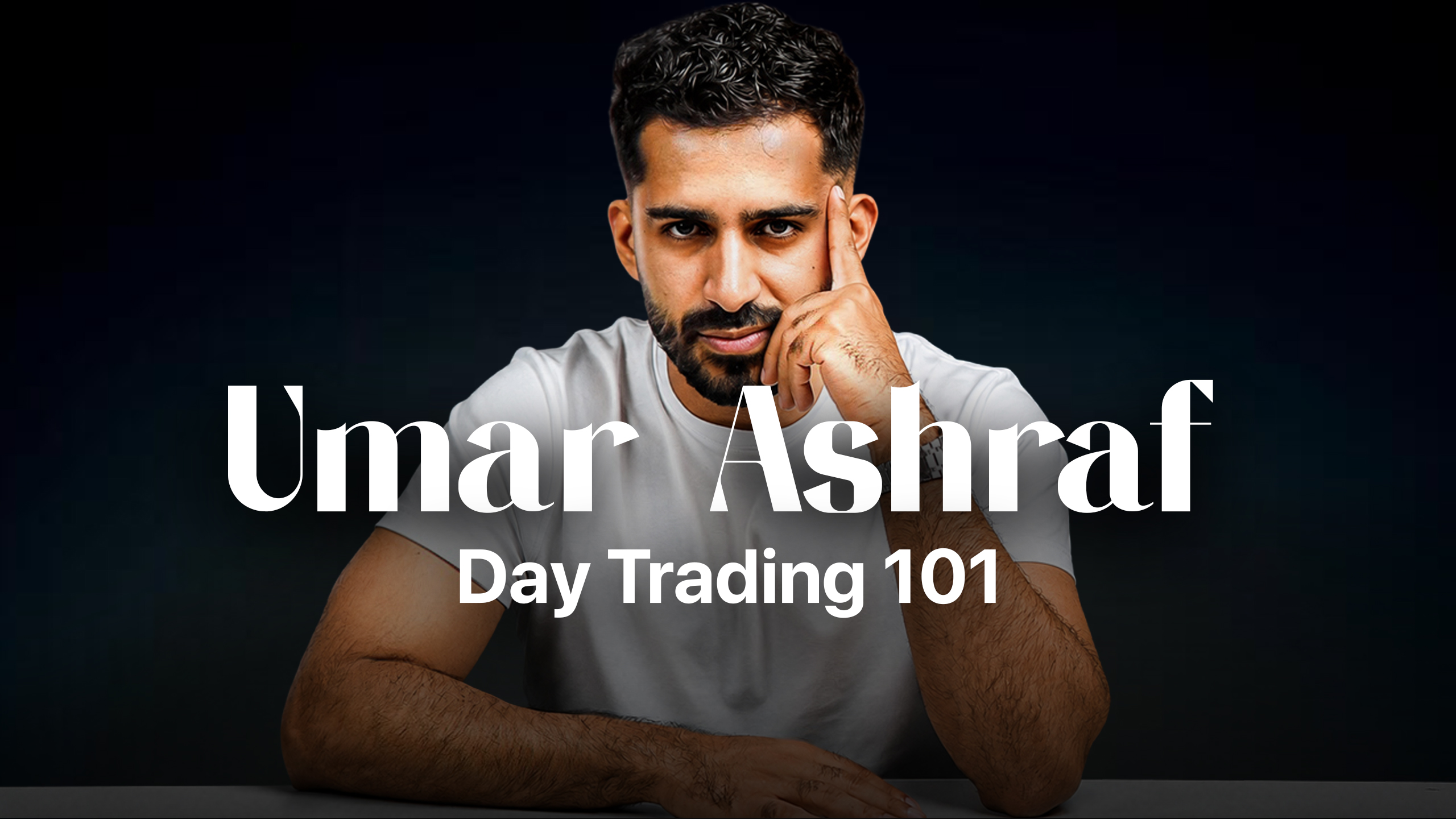
Chart Academy's masterclasses are free, including day trading taught by Umar Ashraf, and broker demo accounts cost nothing. Between the two, every skill except real emotional control is available at zero cost. Save the $100 for the part that isn't.
Chart Academy is the world's first free, all-in-one trading education platform. Get Trading Masterclass taught by world-class traders, plus guides on every market. No subscriptions, no credit card.

.svg)