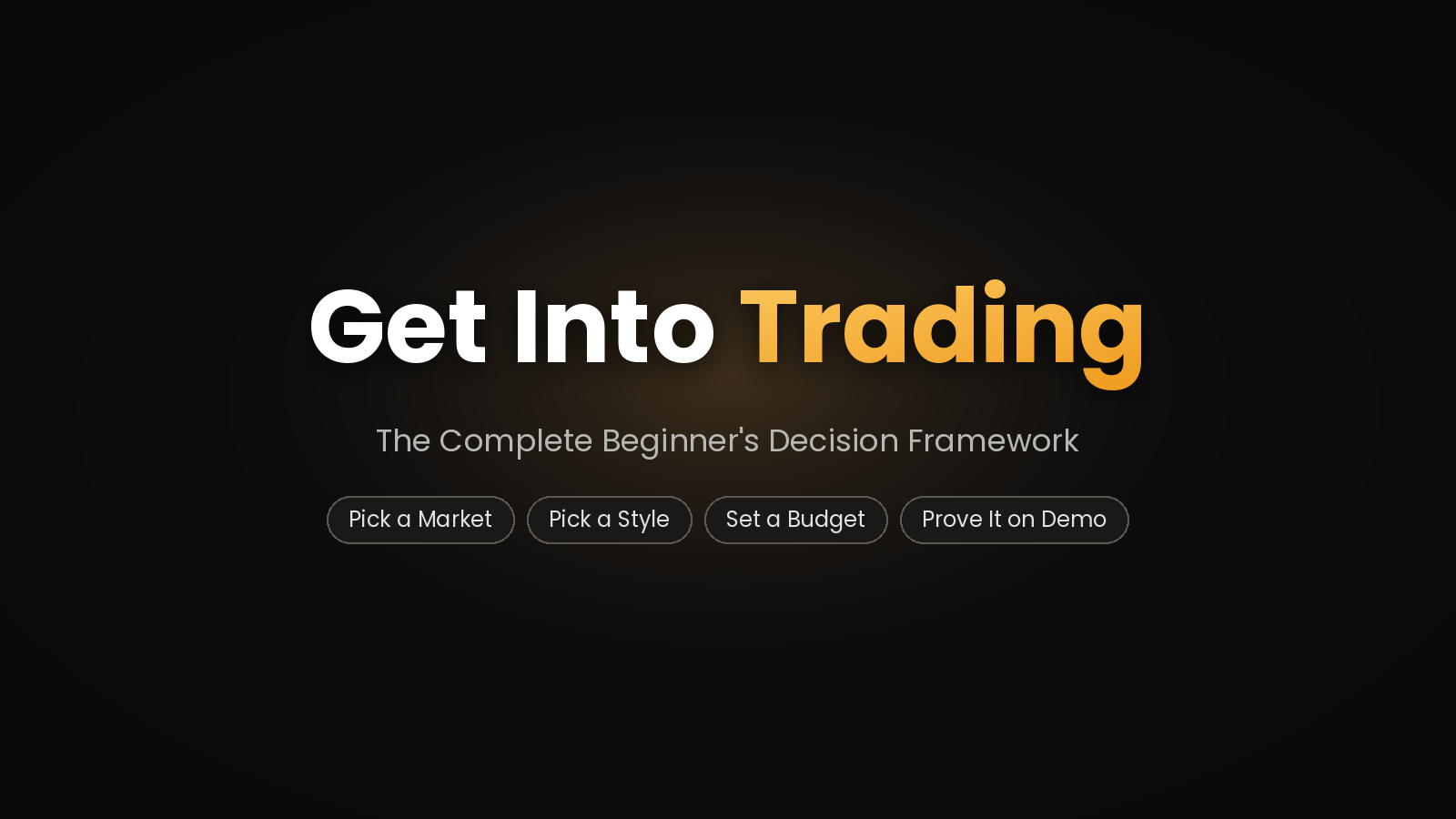
Most people who want to get into trading start in the wrong place. They look for a strategy first. But a strategy is useless until you have answered four bigger questions: which market you will trade, what style fits your life, how much money you will use, and how you will know you are ready.
This guide walks you through those four decisions, one at a time. By the end, you will know exactly what your first six months should look like.
At Chart Academy, we give traders free access to education led by professional traders. If you want the step-by-step account setup after making these decisions, our guide on how to start trading covers that part.
Decision 1: Which Market Should You Trade First?
This is the biggest choice, and most beginners never actually make it. They bounce between stocks, forex, and crypto, and never learn any of them properly. Pick one market and stay with it for at least six months. Skill compounds when it stays in one place.
Here is what each market looks like for a beginner.
Stocks. The most familiar starting point. You trade shares of companies you already know, during fixed market hours, 9:30 a.m. to 4 p.m. ET. The fixed hours are a feature, not a limit: when the market is closed, you cannot overtrade. There is no built-in leverage unless you ask for it, so mistakes stay the size you made them. Start with our stock trading for beginners guide.
Forex. Currency trading runs 24 hours on weekdays, which suits people who can only trade at night. Micro lots let you risk a few dollars per trade, so it is one of the cheapest markets to practice in with real money. The trade-off is that the quiet hours can tempt you into forcing trades when nothing is happening. Our forex trading for beginners guide covers pairs, pips, and sessions.
Futures. Contracts on indexes, oil, gold, and more. Micro contracts have made futures realistic for smaller accounts, and the market trades almost 23 hours a day. Leverage is built in, which means both your wins and your mistakes are multiplied, so risk control matters from the first trade. Start with futures trading for beginners.
Options. Contracts on stocks that can multiply gains and losses. Powerful, but they add a second layer of difficulty on top of normal market analysis: an option can lose money from time passing even when your direction is right. Most people do better learning a simpler market first, then adding options. When you are ready, start with options trading for beginners.
Crypto. Trades 24 hours a day, every day, including weekends. The constant access and big swings make it the hardest place to build discipline as a complete beginner. There is never a closing bell to save you from yourself.
If you have no strong pull toward any of them, stocks are the most forgiving classroom. If your free hours are at night, look at forex or futures.
| Market |
Hours |
Good For |
Watch Out For |
| Stocks |
9:30 a.m. – 4 p.m. ET |
Most beginners |
Slower pace can make other markets look tempting |
| Forex |
24h weekdays |
Night-time traders |
Quiet hours invite forced trades |
| Futures |
~23h weekdays |
Small accounts via micros |
Built-in leverage multiplies mistakes |
| Options |
9:30 a.m. – 4 p.m. ET |
Second market, not first |
Time decay punishes slow trades |
| Crypto |
24/7, no close |
Experienced traders |
No closing bell, hardest place to build discipline |
Decision 2: Which Trading Style Fits Your Life?
The mistake to avoid: choosing day trading because it looks exciting, while only being free at 9 p.m. Match the style to your actual hours, then pick the market that is active during those hours. And accept something traders learn slowly: style is personal wiring, not a ranking. No two people process the market at the same speed, which is why someone else’s exact method, handed to you on a silver platter, still would not work in your hands. A person with a day job and a calm temperament usually belongs in swing trading; a fast decision-maker who hates holding overnight belongs intraday. The goal is not to copy the best trader. It is to become the best version of your own. We compare the two most popular speeds in day trading vs swing trading.
Decision 3: How Much Money Do You Need to Get Into Trading?
Less than most people think, and you should start with less than you can afford.
You can open most brokerage accounts with a few hundred dollars. Micro futures contracts, micro forex lots, and fractional shares mean small accounts can trade real markets with small risk. One old barrier is also gone: the US rule that required $25,000 to day trade stocks frequently was removed in June 2026, though brokers still set their own account requirements.
The real question is not the minimum. It is this: how much can you lose while you learn without it hurting your life? That is your starting amount. A common approach is to begin with $500 to $2,000 and risk no more than 1% of the account on any single trade. On a $1,000 account, that means risking about $10 per trade. Ten dollars sounds too small to matter, and that is exactly the point. The job of your first months is not profit. It is learning to follow rules while real money is on the line, at a size where mistakes are cheap lessons instead of expensive ones.
And before any of that money goes in, the first spend should be zero dollars: education and a demo account.
Decision 4: How Do You Know You Are Ready for Real Money?
Do not use a date. Use evidence. Trade on a demo account first, and move to real money only when you can show yourself three things.
First, a written plan. One page that says what you trade, when you trade, what a valid setup looks like, and how much you risk per trade. If you cannot write it down, you do not have a plan yet, you have a feeling.
Second, a track record of following that plan. At least 20 to 30 demo trades where you took only valid setups and respected your risk rule every time. The results matter less than the rule-following. Profitable demo trades that broke your rules are a warning sign, not a green light, because the habit is what you take to the live account.
Third, a journal. A simple log of each trade: why you entered, where you exited, and one line on how you felt. This is what you will review to find what actually works for you.
When you do go live, start at the smallest size your market allows and treat the first 50 real trades as paid tuition. Increase size only after you have proof, in your own journal, that you can follow your plan with real money on the line.
What Should Your First Six Months Look Like?
Put together, the path looks like this.
Months one and two: pick your market, study it through free masterclasses, and trade it on a demo account while you build your written plan. Months three and four: go live at minimum size, risking around 1% per trade, and journal everything. Months five and six: review your journal, keep what works, cut what does not, and only then think about slowly increasing size.
Slower than the videos on social media promise. Faster than starting over after blowing up your first account.
What Mistakes Do People Make When They Get Into Trading?
Four show up constantly.
Skipping the learning phase and funding an account in week one. Switching markets after every losing week, so no skill ever compounds. Taking trade signals from social media instead of learning to read the market themselves. And sizing up after a few wins, which turns one normal losing streak into real damage.
Notice that none of these are strategy problems. They are decision problems, which is why the framework above matters more than any indicator.
Get Into Trading Free With Chart Academy
Everything in this guide points to the same first step: learn before you fund. That step should not cost you anything.
Chart Academy is a free trading course platform with complete masterclasses from professional traders in stocks, options, futures, forex, day trading, and trading psychology. Pick the market you chose in Decision 1, watch how a professional actually trades it, and practice on a demo alongside the lessons. No subscriptions, no credit card, no upsell at the end.
Pick your market, then learn it from a professional who trades it. Free masterclasses in stocks, options, futures, and forex on Chart Academy.
Start free
Join Chart Academy Free
Chart Academy provides educational content and does not provide financial, investment, or trading advice. Trading involves a substantial risk of loss and is not suitable for everyone. Past performance is not indicative of future results.
How to Get Into Trading FAQs
How do I get into trading with no experience?
Make four decisions in order: pick one market, pick a style that fits your schedule, decide how much money you can afford to learn with, and practice on a demo account until you can follow a written plan for 20 to 30 trades. Free education and a demo account cover the first months without risking anything.
How much money do I need to start trading?
You can open most accounts with a few hundred dollars, and micro contracts and fractional shares let small accounts trade with small risk. The better question is how much you can lose while learning without it hurting you. Many beginners start with $500 to $2,000 and risk about 1% per trade.
Which market is best for a beginner?
Stocks are the most forgiving start for most people: familiar companies, fixed hours, and no built-in leverage. Forex or futures suit people who can only trade at night. Pick one and give it at least six months before judging.
Do I need $25,000 to day trade stocks?
No. The US pattern day trader rule that required $25,000 to day trade stocks frequently was removed in June 2026. Brokers still set their own account minimums, so check yours. Capital was never the main barrier anyway; skill is.
How long does it take to learn trading?
Expect months, not weeks. A reasonable path is one to two months of study and demo trading, then several months of live trading at very small size. Most people who fail rush this timeline.
Can I learn trading for free?
Yes. Chart Academy offers free trading courses from professional traders in every major market, stocks, options, futures, forex, and trading psychology, and every broker offers a free demo account to practice on. Between those two, the entire learning phase costs nothing.