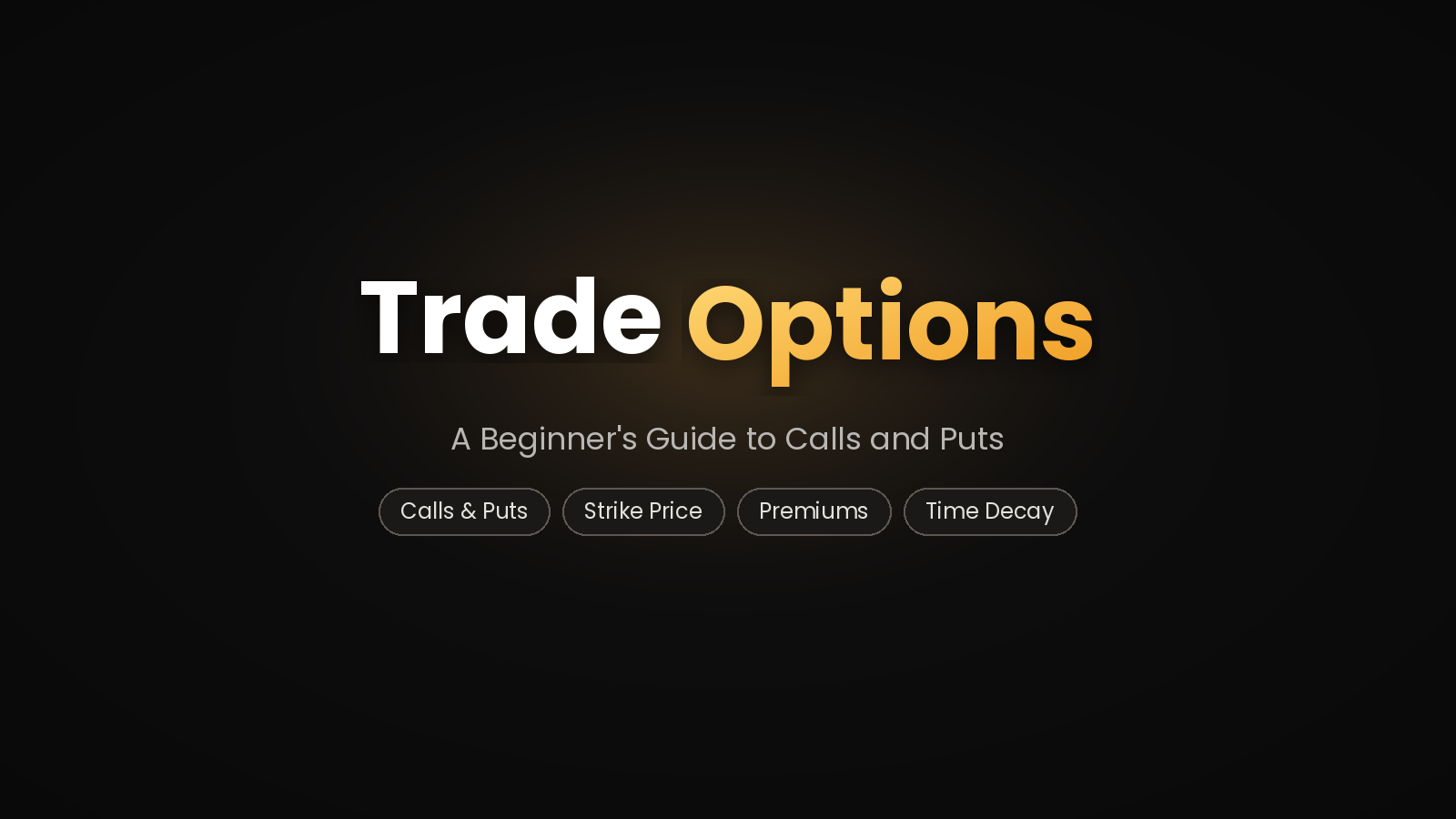
Learning how to trade options can feel confusing at first. You may hear people talk about calls, puts, strike prices, premiums, and expiration dates before anyone explains what an option actually is. Many beginners spend weeks watching videos and still don't understand what happens when they buy a contract.
An option is simpler than the vocabulary suggests. It's a contract about a stock's future price, and once you understand what the contract says, the terms around it start to make sense.
At Chart Academy, we give traders free access to education led by professional traders. This blog explains how options trading works with real numbers, in the order we would want to learn it before buying a first contract.
What Is an Option?
An option is a contract that gives you the right, but not the obligation, to buy or sell a stock at a fixed price, up until a set date. You pay for that right, and the price you pay is called the premium.
Two details matter immediately. First, one standard equity option contract covers 100 shares, so every price you see gets multiplied by 100. An option quoted at $1.50 costs $150 to buy. Second, "not the obligation" is the key phrase for buyers: if the trade goes against you, you can simply let the contract expire, and your loss stops at whatever you paid for it.
Options are contracts about stocks, so if shares themselves are still fuzzy, read what stocks are first. Everything below assumes you know what the underlying stock is.
How Do Call Options Work?
A call gives you the right to buy a stock at a fixed price, called the strike price. You buy calls when you expect the stock to rise.
Here's the math with simple numbers. A stock trades at $50. You buy a call with a $55 strike expiring in two months, and you pay a $1 premium, which is $100 for the contract. That contract now says: any time before expiration, you may buy 100 shares at $55, no matter where the stock trades.
If the stock climbs to $60, the right to buy at $55 is worth at least $5 per share, so your contract is worth around $500. You paid $100. If the stock instead stays below $55 through expiration, the right to buy at $55 is worth nothing, the contract expires, and you lose the $100. That's the whole trade-off: a smaller amount of money controlling a larger position, with the real possibility of losing all of it.
In practice, most traders never actually buy the 100 shares. They sell the option itself before expiration, collecting the change in the premium as their profit or loss.
How Do Put Options Work?
A put is the mirror image: the right to sell a stock at the strike price. You buy puts when you expect the stock to fall.
Same stock at $50. You buy a put with a $45 strike for a $1 premium, $100 total. If the stock drops to $38, the right to sell at $45 is worth about $7 per share, roughly $700 on your $100. If the stock stays above $45, the put expires worthless and the $100 is gone.
Puts are also how investors buy insurance: someone holding 100 shares can buy a put to guarantee a selling price if the stock collapses. That's worth knowing because it explains why options exist at all. They were built for managing risk, and speculation came second.
|
Call Option |
Put Option |
| What it gives you |
The right to buy 100 shares at the strike price |
The right to sell 100 shares at the strike price |
| When traders buy it |
Expecting the stock to rise |
Expecting the stock to fall, or to protect shares they own |
| Maximum loss as a buyer |
The premium paid |
The premium paid |
| Example |
Stock at $50: a $55 call profits if the stock climbs well past $55 |
Stock at $50: a $45 put profits if the stock falls well below $45 |
The Three Numbers on Every Option
Every option is defined by three things, and reading them fluently is half the skill.
The strike price is the fixed price the contract locks in. Strikes above or below the current stock price cost less because they need a bigger move to pay off; traders call those out of the money. Strikes the stock has already passed are in the money and cost more.
The premium is the option's price, quoted per share and paid per 100. It has two parts: intrinsic value, which is how far the option is already in the money, and time value, which is what you pay for the possibility of movement before expiration.
The expiration date is when the contract dies. Most stocks have options expiring monthly, heavily traded ones weekly, and a few index products daily. The shorter the time, the cheaper the option, and the faster it needs to be right.
Why Options Lose Value Over Time
This is the concept that separates people who understand options from people who gamble with them.
An option's time value melts away as expiration approaches, a process traders call time decay. The decay accelerates in the final weeks. That means an option buyer can be roughly right about direction and still lose money, because the stock moved too slowly. A stock that drifts from $50 to $54 over two months may never make your $55 call worth more than you paid.
This is also why cheap, short-dated, far out-of-the-money options empty more beginner accounts than anything else in this market. They cost $20 or $30 a contract and look like an easy chance at a big win, and they're priced that cheap because they almost always expire worthless. Buying them repeatedly is one of the fastest ways to lose an account.
Buying vs Selling Options: Know Which Side You're On
Everything above describes buying options, where your maximum loss is the premium you paid. Selling options is a different business entirely.
The seller of an option collects the premium up front and takes on the obligation side of the contract: if the buyer exercises, the seller must deliver. Selling a call without owning the underlying shares carries theoretically unlimited risk, because there's no ceiling on how high a stock can go. Sellers can also be assigned, meaning the obligation is enforced, sometimes before expiration.
There are sensible, widely used selling approaches, but they belong to a later stage of learning. As a beginner, know this much: buying defines your risk, selling opens it up, and brokers know it too, which is why they approve accounts for options in levels, with selling uncovered options restricted to experienced traders with substantial accounts.
How to Place Your First Options Trade
When you're ready, the mechanics look like this.
First, apply for options approval in your brokerage account. Brokers assign permission levels based on your experience and finances, and they're required to give you the OCC's official disclosure document, Characteristics and Risks of Standardized Options, which is worth actually reading.
Then open the option chain for a stock you know, which is the table of all available strikes and expirations. Choose an expiration with enough time to be wrong for a while, often one to three months rather than days. Choose a strike near the current price rather than a long shot. Use a limit order, because option spreads are wider than stock spreads and market orders overpay. Trade one contract. And plan to close the position well before expiration rather than holding to the end, since the final days are when time decay is fastest.
Before any of that, spend time on a paper trading account. Options move differently from stocks, and watching that difference with simulated money is the safest way to learn how they move. The same rule we teach for stocks applies doubly here: the mechanics should feel boring before real money touches them.
The Mistakes That Empty Beginner Accounts
Four errors do most of the damage.
Buying cheap, short-dated options. Far out-of-the-money contracts expiring this week. Priced cheap because they nearly always lose.
Sizing like it's stock. Options can lose their entire value in days, and regularly do. Money you put into a single options trade should be money you can watch go to zero without flinching, and it should be a small slice of your account.
Holding through big events. Option prices inflate before earnings and major announcements because a big move is expected. If the move disappoints, the option can lose value even when the stock goes your way, an effect traders call a volatility crush.
Selling what you don't understand. Collecting premium feels like easy income until an assignment or an unlimited-risk position shows why it wasn't. Learn the buying side thoroughly first.
Options make more sense when someone shows you. Usman Ashraf's options masterclass is free on Chart Academy.
See the masterclass
Learn How to Trade Options With Chart Academy
You now know what an option actually is: a contract with a strike price, a premium, and an expiration date. That's the foundation, and the next layer is seeing how a professional actually uses it.
Chart Academy's options trading course is taught by Usman Ashraf, a professional options trader, as a full masterclass: how he reads an option chain, how he manages risk, and when he stays out. It costs nothing to watch, and there's no credit card or subscription involved. Pair it with your broker's paper trading mode and you can learn this entire market before risking a single premium.
Join Chart Academy Free
Chart Academy provides educational content and does not provide financial, investment, or trading advice. Trading involves a substantial risk of loss and is not suitable for everyone. Past performance is not indicative of future results.
Frequently Asked Questions
How do beginners trade options?
Start by learning the mechanics: calls, puts, strikes, premiums, and time decay. Get options approval from your broker, practice on a paper trading account, then trade one contract at a time, buying rather than selling, with expirations far enough out to survive being early.
How much money do you need to trade options?
It depends on the contract you trade. Premiums range from a few dollars to several thousand, based on the stock, the strike, and the time to expiration. The money at risk can go to zero quickly, so trade from an account where losing several full premiums changes nothing about your life. Broker approval requirements also vary.
Are options riskier than stocks?
Different rather than simply riskier. A bought option can lose 100 percent of its value quickly, which stocks rarely do, but the loss is capped at the premium. Sold options can carry far larger risk. The danger level depends mostly on which side of the contract you're on and how you size it.
What happens if my option expires?
An option that expires worthless simply disappears, along with the premium you paid. An option that expires in the money is typically exercised automatically, which can result in buying or selling 100 shares. Most traders close their positions before expiration to avoid surprises.
Do I need special permission to trade options?
Yes. Brokers require an options application and assign approval levels based on your experience, finances, and objectives. Basic strategies like buying calls and puts sit in the lower levels; selling uncovered options requires the highest approvals.
Can you lose more than you invest with options?
As a buyer of calls and puts, no. Your maximum loss is the premium you paid. As a seller of uncovered options, yes, losses can far exceed the premium collected, which is exactly why selling belongs to a later stage of learning.
What's the best way to learn how to trade options?
Watch how a professional does it, then practice it yourself. Chart Academy's Options Masterclass, taught by professional options trader Usman Ashraf, covers the full framework across six free lessons, from reading an option chain to managing risk. Applying each lesson on your broker's paper trading account turns the concepts into skill before any premium is at risk.






.svg)